
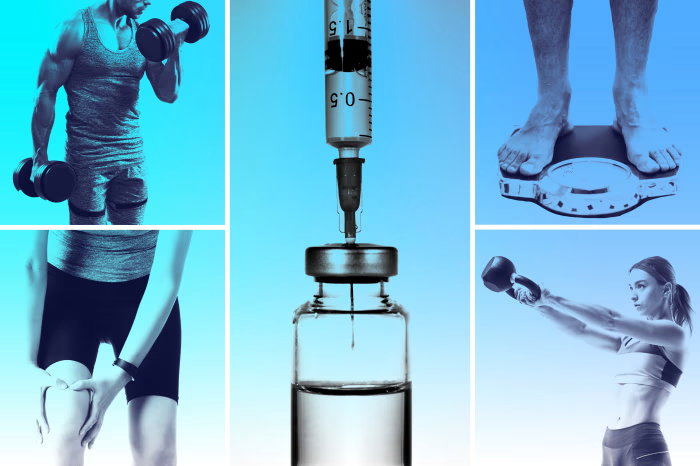
Peptides for injury recovery: what the evidence actually says
Patients arrive in my clinic almost every week asking about BPC-157, TB-500 and the other peptides being marketed for faster tendon, ligament and muscle healing. The honest answer is shorter than the marketing — and more useful.
A patient sat opposite me last month with a torn supraspinatus tendon and a recovery plan he had built himself. Physiotherapy. Strength work. A six-month timeline. And, in his bag, three small glass vials of a peptide he had bought online for £180 a vial. He had heard about it on a podcast. The presenter was confident. Three friends had used it. He wanted to know whether to inject the first dose tonight.
The question he was asking is the one I now hear most often in clinic. It is reasonable. The wellness industry has done an effective job of pulling peptide therapy out of the bodybuilding fringe and into the conversation of people who simply want to recover faster from a sports injury. The pharmacology is real. The marketing is loud. The evidence — that is the part patients rarely see.
What peptides actually are
Peptides are short chains of amino acids — the same building blocks as proteins, just smaller. Our bodies use them all the time to regulate healing, inflammation and growth. The peptides being sold for injury recovery are synthetic versions, designed to mimic or amplify natural signalling. Two have dominated the conversation:
BPC-157 is a 15-amino-acid peptide derived from a protein found in human gastric juice. In rat studies it accelerates healing of tendon, ligament, muscle and bone injuries at remarkably low doses. It promotes new blood vessel growth, recruits fibroblasts, and shifts the immune response towards repair.
TB-500 is a fragment of thymosin β4, a naturally occurring peptide that binds actin and supports cell migration. It has been studied for everything from cardiac repair after heart attack to corneal wound healing.
Mechanistically, both compounds look promising. The cellular pathways they activate — angiogenesis, fibroblast recruitment, anti-inflammatory signalling — are exactly the ones that limit how quickly an injured tendon or ligament can heal. The trouble starts when you ask what happens when you give them to actual patients.
"The laboratory data is interesting. The human evidence is three small uncontrolled studies in sixteen patients between them. No proper trial. No dosing standard. No long-term safety data. That is not enough to recommend an injection."
What the evidence really shows
I led a scoping review of the entire peptide-and-musculoskeletal-injury literature this year. We mapped every study, every peptide, every tissue type — rodent and rabbit work, in vitro experiments, registered trials, regulatory documents from five countries. The picture is striking, and it is not the one the marketing suggests.
How strong is the human evidence?
By peptide, for musculoskeletal injury healing
Author's qualitative scoring across replication, sample size, design quality and indication relevance. PRP and BMP-2 are licensed orthobiologics shown for comparison.
For BPC-157, there are exactly three published human studies. All from one private clinic in Florida. Sixteen patients in total. No control groups. No randomisation. No standardised diagnosis. The largest of them reported pain relief in a mix of knee conditions; the smallest involved two healthy volunteers being given the drug intravenously to check for short-term safety. That is the entire human evidence base in 2026.
For TB-500, the picture is similar. There is no completed Phase 2 or Phase 3 trial in tendon, ligament, muscle or bone injury. The credible human data we do have is for dermal and corneal wound healing — not for the things patients are buying it for.
The replication problem
Almost every published BPC-157 study comes from one research group in Croatia. They have done excellent work for thirty years. But in medicine, a finding becomes solid when independent groups around the world reproduce it. For BPC-157 and musculoskeletal healing, the independent replication is essentially one group in Taiwan with three papers. Compare that to platelet-rich plasma, which has been studied by dozens of institutions on four continents.
The supply problem nobody talks about
Here is the part of the conversation that gets least attention. When a patient buys peptides online, what arrives in the post is frequently not what the label says.
Independent testing of more than seven thousand grey-market peptide samples found that the actual amount of drug in the vial diverged from the advertised quantity by up to 46 per cent at the high end. Roughly one in twelve samples contained measurable endotoxin — a bacterial breakdown product that can cause fever, sepsis-like reactions, and rare but serious organ injury. These products are made for "research purposes only", which is a legal fiction that allows them to bypass pharmaceutical manufacturing standards.
If a patient is willing to inject something into their shoulder, the bare minimum is that the substance is what the label says, is sterile, and is free of bacterial contamination. The grey market does not consistently deliver any of those three things.
- 3
- Published human BPC-157 studies for musculoskeletal use — all from one private clinic.
- 16
- Total patients across all three studies combined.
- 0
- Phase 2 or Phase 3 randomised trials of any peptide for tendon, ligament or muscle injury.
- ±46%
- Quantity divergence in grey-market peptide samples vs the label, at the 95th percentile.
- 4 yr
- WADA sanction for athletes testing positive — the established precedent (Brooks, 2025).
- £180
- Typical online cost of a single 5 mg vial of unregulated BPC-157.
If you compete in tested sport, stop here
BPC-157 has been on the World Anti-Doping Agency Prohibited List since January 2022. TB-500 has been banned since 2011. CJC-1295 and ipamorelin are both prohibited as growth-hormone-releasing peptides. In April 2025 a Canadian university volleyball player received a four-year ban after testing positive for BPC-157 and TB-500. That is the operative precedent.
If you are subject to anti-doping testing — at any level, in any sport, including masters and amateur competitions that operate under WADA rules — these peptides will end your competitive career for four years. The clinical evidence is too weak to take that risk.
The three cards I show in clinic
When a patient brings me a bottle of peptides, I do not lecture. I show them three things to think about. They are the same three I would want anyone in my family to consider before injecting themselves with anything.
Has it been tested in humans for what I have?
For tendon, ligament, muscle, bone and cartilage injury: no peptide on the market has a completed Phase 2 or Phase 3 trial. The animal data are interesting. They are not human data.
Who made the vial?
If you cannot name the manufacturer, the batch, and see the certificate of analysis, you do not know what is in it. Independent testing shows up to 46% dose deviation and 8% endotoxin contamination in grey-market supply.
What happens if something goes wrong?
An infection from a contaminated injection. A reaction nobody can attribute because the substance is not licensed. A four-year ban from your sport. None of these are remediable after the fact.
What I do recommend
None of this means there is nothing to be done. Recovery from a tendon, ligament or muscle injury can be slow and frustrating. But the things that genuinely speed it up are not the things being sold online.
Progressive loading rehabilitation, designed for the specific tissue and the specific injury, has the strongest evidence base of anything in this field. It is not glamorous. It works. Sleep, protein intake, and managing systemic inflammation through everyday means have larger effects than any unproven injectable. For some tendinopathies, platelet-rich plasma has a defensible evidence base, although it is not a magic bullet either. And in the right cases, surgery, performed well and rehabilitated properly, remains the most reliable way to restore function.
In the future, one or more of these peptides may have a place in our toolkit. A properly designed multi-centre randomised trial of BPC-157 in rotator cuff repair, or thymosin β4 in Achilles tendinopathy, could change my answer. Those trials have not yet been done. Until they are, the responsible position is to wait — and to be honest with patients about why.
If you are still thinking about it
Some patients will go ahead anyway. I would rather they did so with their eyes open. If you are determined to try a peptide for an injury, three questions deserve a clear answer first.
- Has anyone you trust — a doctor, a physiotherapist, a researcher with no financial interest — looked at the actual evidence and recommended this for your specific injury?
- If you compete in any tested sport, even occasionally, are you willing to accept a four-year ban as a possible outcome?
- Can you verify the manufacturer, the batch number, and the certificate of analysis for the vial in your hand?
If the answer to any of those three is no, my advice is to wait. The evidence may catch up. It has not yet.
The right injury plan is rarely the one being marketed online.
If you have a tendon, ligament or sports injury that is not healing the way you expected, I see patients privately and at Ashford & St Peter's. A consultation is a chance to look at the actual diagnosis, the actual evidence for your case, and a plan that does not depend on hope.
Book a consultation →